

Hiring your first employee in the Netherlands is often where a market entry stops being theoretical. Payroll is a recurring legal obligation, not a one-time task, and the right structure depends on your plans, budget, and how long you expect to operate here.
At Beyond Consultancy, we provide payroll services in the Netherlands for foreign companies, helping employers hire compliantly and budget accurately. This guide breaks down what Dutch payroll costs, what’s legally required, and which setup options are available.
What Do Payroll Services in the Netherlands Actually Include?
Dutch payroll services involve much more than simply calculating an employee’s monthly salary. A full-service provider typically manages:
- Monthly wage tax calculation and filing
- Employee insurance contribution calculations, including WW, WIA and WHK
- Health insurance contribution processing
- Statutory holiday allowance accrual and payout
- Payslip generation that meets Dutch legal requirements
- Pension contribution administration, where applicable
- Employment contract compliance
- CAO checks and related payroll requirements
For international employers, a payroll provider can also serve as a local point of contact for Dutch tax authorities, pension funds, and other relevant institutions. This can be particularly valuable when payroll is being managed from a head office outside the Netherlands.

Payroll Outsourcing vs. Employer of Record
Before choosing a payroll structure, it is important to understand who the legal employer is. Payroll outsourcing and an Employer of Record (EOR) are not the same.
- Payroll Outsourcing: Your company remains the legal employer, while the payroll provider handles payroll administration, filings, contributions, and payslips.
- Employer of Record (EOR): The Employer of Record becomes the legal employer and handles the applicable employer obligations, while you manage the employee’s day-to-day work.
The difference is simple: with payroll outsourcing, you remain the employer; with an EOR, the provider becomes the employer.

Four Ways to Structure Netherlands Payroll
Foreign companies do not always need to incorporate a Dutch entity before hiring. However, the employer still needs to meet statutory obligations, from wage tax withholding to holiday allowance. That someone can be your own foreign company, a Dutch entity, or a specialist provider, and the difference comes down to who is the legal employer and whether a Dutch entity is required.
| Legal Employer | Dutch Entity? | Best For | |
| Foreign employer registration | Foreign company | No | A small number of direct hires, no local entity yet |
| Payroll outsourcing | Foreign company or Dutch BV | Not necessarily | Companies that want payroll administration handled externally |
| Employer of Record | The EOR provider | No | First or quick hires, testing the market |
| Dutch BV, in-house or outsourced | Dutch BV | Yes | Long-term, growing local operations |
- Foreign Employer Registration allows your overseas company to remain the legal employer and register directly for the relevant Dutch payroll obligations without first incorporating a Dutch BV. It is often suitable for an initial hire when the company is not yet ready to establish a local entity.
- Outsourced Payroll allows your company to remain the legal employer while a specialist provider handles payroll calculations, filings, contributions and payslips.
- Employer of Record solutions provide a rapid path to market entry by bypassing local incorporation requirements. It is critical to note that EOR arrangements do not inherently cover visa requirements; should your hire necessitate a work or residency permit, you must verify the specific business immigration pathway and the provider’s credentials as a recognized sponsor independently.
- A Dutch BV makes sense once you’re building a permanent presence. It gives you full control and scales with headcount, but incorporating purely to hire one employee usually costs more time and money than starting with an EOR.
Netherlands Payroll Requirements Foreign Employers Must Meet
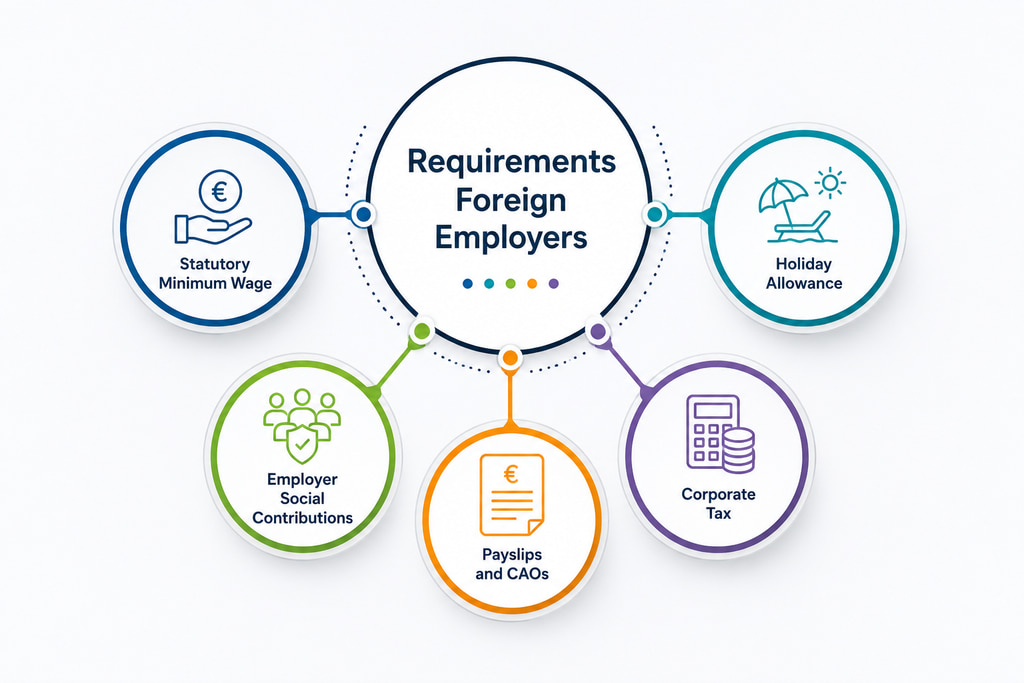
Once you have chosen a structure, you need to determine which Dutch employment, payroll tax and social security obligations apply. In most cases where an employee works structurally in the Netherlands, significant Dutch statutory requirements will apply, regardless of whether the employer is a foreign company, Dutch BV or EOR. These are the core obligations every payroll setup in the Netherlands has to satisfy, and the ones foreign employers most often get wrong when budgeting or drafting contracts.
- Statutory Minimum Wage: Reviewed every 1 January and 1 July. For employees 21 and over: €14.71/hour from 1 January 2026, rising to €14.99/hour from 1 July 2026
- Holiday Allowance: At least 8% of gross annual salary, a statutory obligation under the Wet minimumloon en minimumvakantiebijslag not discretionary, usually paid in May or June.
- Employer Social Contributions: Calculated up to a capped base of €79,409 for 2026. Zvw (health insurance) is 6.10% up to that cap, plus WW and WIA/WHK contributions varying by contract type and sector. As a planning guide, total contributions typically add around 18–25% on top of gross salary, before pension contributions where applicable.
- Payslips and Caos: Every payslip must show gross/net salary, the applicable minimum wage, and all deductions. A large share of Dutch employees also fall under a sector CAO that can set pay above the statutory minimum.
- Operating through a Dutch BV: If your Dutch business operates through a taxable entity such as a BV, corporate income tax may apply to its taxable profits. For 2026, the rate is 19% on taxable profit up to €200,000 and 25.8% on profit above €200,000.
Not sure which structure or obligations apply to your business? Learn more about the Netherlands corporate tax rates for 2026 with Beyond Consultancy before your first employee starts.
How Much Does Payroll Cost in the Netherlands?
Two numbers matter: cost of employment and cost of the service.
Cost of Employment = Gross salary + statutory holiday allowance + employer contributions + pension (where applicable)
Payroll tax and employer contributions can also affect the total cost of employing someone in the Netherlands, depending on the employment structure and salary.
For a closer look at the taxes and employer contributions that can affect your total payroll costs, see our guide to Netherlands payroll tax.
Cost of the service depends on headcount, contract complexity, and whether it’s bundled with HR, accounting, or immigration. EOR fees generally run higher than basic payroll outsourcing, since the provider takes on broader employer liability. The most common first-year surprise is assuming gross salary is close to the full cost of a hire.
Common Mistakes & What to Check Before Choosing a Provider
Mistakes foreign employers most often make:
- Underestimating true employer cost by budgeting on gross salary alone
- Missing CAO applicability and assuming the statutory minimum is the only benchmark
- Treating payroll as a one-time setup task instead of a recurring monthly obligation
- Confusing payroll outsourcing with an EOR
- Using disconnected providers for payroll, immigration, and accounting
Before signing with any provider, confirm:
- Who is the legal employer
- What’s included in the monthly fee
- Who handles tax administration and compliance
- Whether immigration support is available
- Whether the service can scale as you hire more people
A lower monthly fee isn’t the better deal if key services are excluded.
Why Businesses Choose Beyond Consultancy for Dutch Payroll
Payroll rarely stands alone, it usually sits alongside incorporation, immigration sponsorship, and accounting. Beyond Consultancy manages all of it as a single point of contact:
- Netherlands payroll services, with or without a local entity
- Business immigration and IND-recognized sponsorship
- Dutch BV incorporation
- Dutch corporate bank account assistance
- Accounting and tax compliance support
If you’re planning to hire in the Netherlands and want a clear, accurate picture of the true cost and the fastest compliant path forward, Beyond Consultancy can map it out for you.
Get Your Netherlands Payroll Cost & Setup Assessment
Set Up Your Dutch Payroll Right From Hire One
Dutch payroll rewards preparation and punishes assumptions. Between statutory holiday allowance, capped contributions, CAO obligations, and a minimum wage that changes twice a year, the cost of getting it wrong compounds fast.
Beyond Consultancy helps foreign companies establish and manage compliant Dutch payroll from their first hire onward, using the structure that best fits their operations.
Frequently Asked Questions
Do foreign companies need a Dutch entity to run payroll in the Netherlands?
No. A foreign company can in certain circumstances employ staff in the Netherlands without incorporating a Dutch entity, for example by registering as a foreign employer. Alternatively, an EOR can act as the legal employer. Whether establishing a Dutch entity is advisable depends on the company’s wider activities and long-term plans in the Netherlands.
Does hiring an employee in the Netherlands create a permanent establishment?
Not automatically. Registering as a foreign employer does not by itself determine whether your company has a permanent establishment in the Netherlands. The employee’s activities, authority, working arrangements and the applicable tax treaty can affect the assessment. Permanent-establishment risk should therefore be assessed separately from payroll registration.
What is the real cost of employing someone in the Netherlands?
Beyond gross salary, budget for an 8% statutory holiday allowance and approximately 18–25% in employer social contributions, plus pension where applicable.
Is an EOR better than setting up a Dutch BV?
It depends on your plans. An EOR suits a first or short-term hire; a Dutch BV is generally the better fit once you’re building a permanent, growing Dutch operation.
How often do Dutch payroll rates change?
The statutory minimum wage is reviewed twice a year (1 January and 1 July). Social contribution rates and caps are typically updated annually.
Can I switch from an EOR to my own Dutch entity later?
Yes, a common growth path. Companies start with an EOR to hire quickly, then transition employees onto their own entity’s payroll once headcount or long-term commitment justifies incorporation.
What happens if a foreign employer doesn’t comply with Dutch payroll rules?
Non-compliance can trigger fines from the Dutch Labour Authority, back-pay claims from employees, and retroactive tax and contribution assessments. It’s far cheaper to get the structure right upfront than to correct it after the fact.
Does payroll work differently for EU vs. non-EU employees?
While the fundamental administrative payroll process remains constant, business immigration status introduces critical variations in employer obligations. Most EU/EEA and Swiss citizens possess inherent labor market access without a separate work permit, whereas third-country nationals often require specific residency or employment authorization before they can be added to your payroll. Furthermore, international social security treaties may shift where contributions are due, making it essential to verify the correct withholding setup for cross-border personnel.
